Monday, May 14, 2012

Oops!!!

The Daily Mail reported this interesting piece:
If the world ends on December 21, blame a German butterfingers who dropped a volcanic rock skull once owned by SS overlord Heinrich Himmler in his laboratory this week.

According to legend, the Mayan skull, which was stolen from Tibet by the Nazis and imbued for believers with magical powers to enable mankind to survive an apocalypse, fell and chipped during a photo shoot.

* * *

'It was probably put down somewhere a bit wobbly,' an eyewitness told a German newspaper.

'Suddenly it crashed to the floor. A big piece broke off the chin. It's really tragic.'

Thomas Ritter, an historian who owns the skull, said it was given to him by the family of a former British soldier present at the 1945 arrest of Himmler, who ran the Gestapo, the SS and the extermination programme which murdered six million Jews.

He added that he believed its accident wouldn't 'anger the Gods' and that the world will still be turning on December 22.

The skull is 1,000 years old and one of the legendary Mayan skulls that belonged to the lost, ancient race of Mexico, which were said to be infused with magical powers.

The 3lb skull is made of volcanic rock and, according to Ritter, was seized by SS men sent on an expedition to Tibet between 1937 and 1939 to look for the lost city of Shangri-La.

Ritter said: 'The Nazis were convinced that 13 such skulls existed and that whoever owned them would have control of the world.'

Nine Great Archeological Mysteries

A slide show from Fox News. They have links to further stories and/or news sites. Number 10 is interesting to me: underwater terrain that must have been above the water at one time.


Buried deep beneath the sediment of the North Atlantic Ocean lies an ancient, lost landscape with furrows cut by rivers and peaks that once belonged to mountains. Geologists recently discovered this roughly 56-million-year-old landscape using data gathered for oil companies.

"It looks for all the world like a map of a bit of a country onshore," said Nicky White, the senior researcher. "It is like an ancient fossil landscape preserved 2 kilometers (1.2 miles) beneath the seabed."

So far, the data have revealed a landscape about 3,861 square miles (10,000 square km) west of the Orkney-Shetland Islands that stretched above sea level by almost as much as 0.6 miles (1 km). White and colleagues suspect it is part of a larger region that merged with what is now Scotland and may have extended toward Norway in a hot, prehuman world.

Monday, May 7, 2012

The Zombies Hate Stuff Book

Review (and some illustrations) here. I like the zombie impaled on the unicorn's horn.

Sniper Elite v2

The Truth About Guns reviews a video game called "Sniper Elite" version 2:
[In the game] you play as an OSS Secret agent inserted into Berlin during the final days of World War II to stop the Soviets from obtaining some deadly new technology. Your targets are German V2 scientists. 
... Sniper Elite V2′s claim to fame is its new X-Ray Kill Cam. This feature shows the damage a round from your rifle does to an opponent with gruesome detail. The camera doesn’t activate during every kill, only those that require significant skill to pull off. This is made vastly more difficult by Sniper Elite’s inclusion of bullet-drop and windage.

Much like in real life, bullets don’t travel at the speed of light (yet) and are affected by wind. What this means to the player is that, based on his wind meter and the range to target, you have to utilize the mil dots on his scope to compensate for the ballistic trajectory of the round. That makes you really “earn” each kill unlike more mainstream games like Call of Duty which utilize instant hit-scan projectile tracking.
I know its not a zombie game, but any game that attempts to accurately portray ballistics may be worth a look.

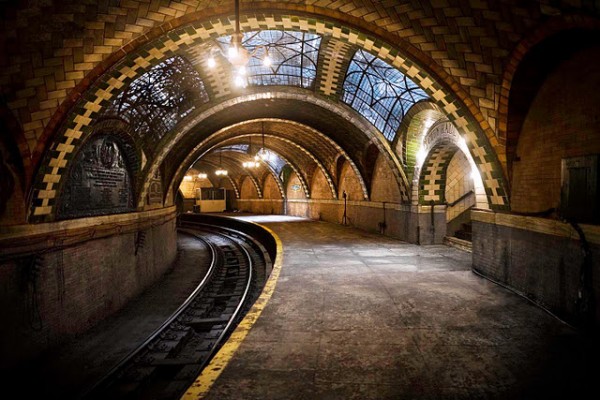
"New York City's Hidden Subway Station"


Another "modern ruins" story, this time about an abandoned subway station in New York City. (Full story here).
It was opened in 1904, with the hope of making it the crowning glory of the New York subway system in elegant architecture and a place for commemorative plaques to honour the work that had resulted in such a successful underground mass transit system. It was to be the original southern terminus of the first ‘Manhattan Main Line’; however the station was closed and boarded up in 1945. The gem of the underground began gathering dust, forgotten by the general public, as passengers were forced off at the Brooklyn Bridge Stop before the train continued on to the terminus to make its turnaround.

The reason for its closure was that newer longer cars were required to match the demand of passengers that passed through the system. But as the stations tracks were severely curved, a dangerous gap between the train doors and the platform was formed making it an unsafe area. This combined with the fact that only about 600 people used it, resulted in its closure with only mythical plans of turning it into a transit museum. But this was never followed through.
Amazing. More information and photos at the link.

The Sea Beast of Cincinnati

The collective brainpower of several dozen scientists was unable to unravel the mystery of a strange beast nearly half a billion years old, tentatively nicknamed “Godzillus.”

Ron Fine, an amateur paleontologist from Dayton, Ohio, hoped the supersmart group of scientists at a regional meeting of the Geological Society of America could help explain the baffling find he made recently: the fossil of a very large, very mysterious "monster" that lived near Cincinnati 450 million years ago.

Unfortunately, the sea beast of Cincinnati had them scratching their heads, too.

“Everybody else was just as puzzled as we are -- and personally, I think that’s pretty awesome,” Fine told FoxNews.com.

He found the fossilized specimen last summer, a roughly elliptical shape with multiple lobes totaling almost 7 feet in length. It dates from almost half a billion years ago, when a shallow sea covered Cincinnati.

And despite its size, no one has ever found a fossil of this “monster” until its discovery by the amateur paleontologist last year.

But neither Fine nor the other members of the Dry Dredgers, an association of amateur paleontologists based at the University of Cincinnati that has a long history of collaborating with professional scientists, could explain what it is.

“We all have a theory, that’s the problem! We’re considering both animal and plant,” Fine told FoxNews.com. “We know it’s a fossil, something that was alive. But it’s so different than anything else, we can’t tell if it's animal or plant.”
450 Million years old; approximately 7 feet tall; neither plant nor animal. Only one thing it could be...
 
(Source: ghostsandmurder.com)
 
... one of the "Old Ones" (aka, Elder Ones or Elder Things), described as:
Starfish-like entities which are part animal and part plant. They lived on our planet in ancient times, and warred with both the mi-go and the spawn of Cthulhu. The Elder Things were great scientists, and created humanity as food or a joke. They eventually abandoned their Antarctic city to live underwater, and it is unknown whether they have become extinct.

Scientists Insert Ancient DNA Into Modern Bacteria

Playing with fire....
Millions of years ago, a bacterial gene began evolving, and evolving, and evolving...

That bacteria turned out to be E. Coli, and now it lives in the intestines of warm-blooded creatures like us, generally harmless except when it gives us a bout of food poisoning.

Now scientists at Georgia Tech University have re-wound the clock, synthesising one of the genes called EF-Tu as it was 500million years ago, and inserting the ancient gene into E. Coli in place of the modern sequence.

The researchers - making reference to hit 1993 film Jurassic Park - say they are curious to see if 'life finds a way'.Their experiment aimed to watch evolution in action - seeing if the gene follows the same evolutionary path as the modern bacteria, or if it takes a different route altogether.